
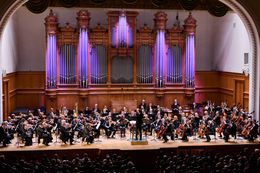
This evening at the Lviv National Philharmonic, the program "Beethoven, Brahms" will be performed — a concert in the Ludkevych Concert Hall at 7 Chaykovskogo Street, scheduled for Friday, June 19, 2026, at 18:00. The format here is very appealing for those who love grand symphonic gestures without unnecessary academicism: both Beethoven and Brahms are featured in the program, promising dramatic scope, real orchestral tension, and that same effect of "coming out of the concert a little different than you went in."
About the Event
This is a live sound concert featuring Marko Komonyk on violin, the Academic Symphony Orchestra of the Lviv National Philharmonic, and conductor John Moon from the USA. The official page states that the event will last from 18:00 to 20:00, making it a neat evening format without the feeling that you've spent half the night in the hall. Tickets for the event are priced between 220–700 hryvnias.
The program includes Symphony No. 5 by Ludwig van Beethoven, Violin Concerto in D Major by Johannes Brahms, and "Nocturnalia" by Rydgio. The philharmonic separately notes that "Nocturnalia" is a contemporary work dedicated to the people of Ukraine, and this evening will see its orchestral premiere performed by the Lviv National Philharmonic.
Plot and Mood
Although it is not a performance with a plot in the literal sense, the program has a very clear dramaturgy: Beethoven enters as music of tension, struggle, and breakthrough, while Brahms represents expansive, noble symphonicity with a generous violin line, and the contemporary "Nocturnalia" adds a more intimate, nocturnal shade to the evening. On the event page, Beethoven's Fifth is described as a piece where the famous first four notes are not just a beginning but a challenge that runs through the entire symphony to a bright finale.
To better feel the rhythm of the evening, one can imagine it like this: first — the music of great inner struggle, then — an expansive Brahms with the soloist in the spotlight, and finally — a contemporary piece written in a completely different language but with very human emotion. That is why this concert can appeal to both those who love classical music "full force" and those who want to hear something not entirely standard within the familiar symphonic evening.
Production
In terms of production, this is not a theatrical event but a concert, so the main focus here is on the performers and the orchestral sound. At the center of the evening is violinist Marko Komonyk, who will perform the Brahms concerto, while John Moon will be at the podium. The event description also mentions that the workshop will be curated by the orchestra's chief conductor Theodor Kuchar, and listeners will be able to attend rehearsals from June 16 to 19.
Visually, this will likely be a classic philharmonic evening without excessive stage decoration, where everything relies on the quality of the performance. Such concerts often resonate the most with those who want not a "show" but live music that can be listened to attentively and almost physically felt in the hall.
How to Get There, Duration, and Intermissions
The venue is located in the Ludkevych Concert Hall of the Lviv National Philharmonic at 7 Chaykovskogo Street in Lviv. The official page clearly states the event time as 18:00–20:00, making it a two-hour evening. There is no information about the number of intermissions on the event page, so promising anything here would be incorrect.
Prices and Audience
Tickets are priced between 220–700 hryvnias, so this is a case where you can choose a format for a calm solo evening, a cultural date, or a meeting with friends. If you love symphonic classics, you definitely won't be bored: Beethoven provides drama, Brahms — breadth, and the contemporary "Nocturnalia" adds a sense of an event that not only repeats the canon but slightly expands its boundaries.
For a newcomer, this is also a good entry into the classical concert world, as the program is built on very recognizable names and works. However, if you expect light background music that requires no attentive listening, this evening will likely ask for more of your attention — but it will reward you with stronger impressions.
Tips for the Audience
It's best to arrive a little early for such a concert to calmly enter, find your seat, and prepare for listening without haste. The dress code is informal yet tidy: the philharmonic does not require an evening dress or suit, but a concert evening is still better experienced in attire that feels comfortable and appropriate in the hall.
If there is an intermission, it's a good moment not only for coffee or a stroll in the foyer but also for a brief "switching" between different musical worlds of the program: from Beethoven to Brahms and then to contemporary sounds. Do you prefer such an evening — when you can come for two calm hours of symphonic music after work, or would you choose a concert with a longer free time before/after the event?