
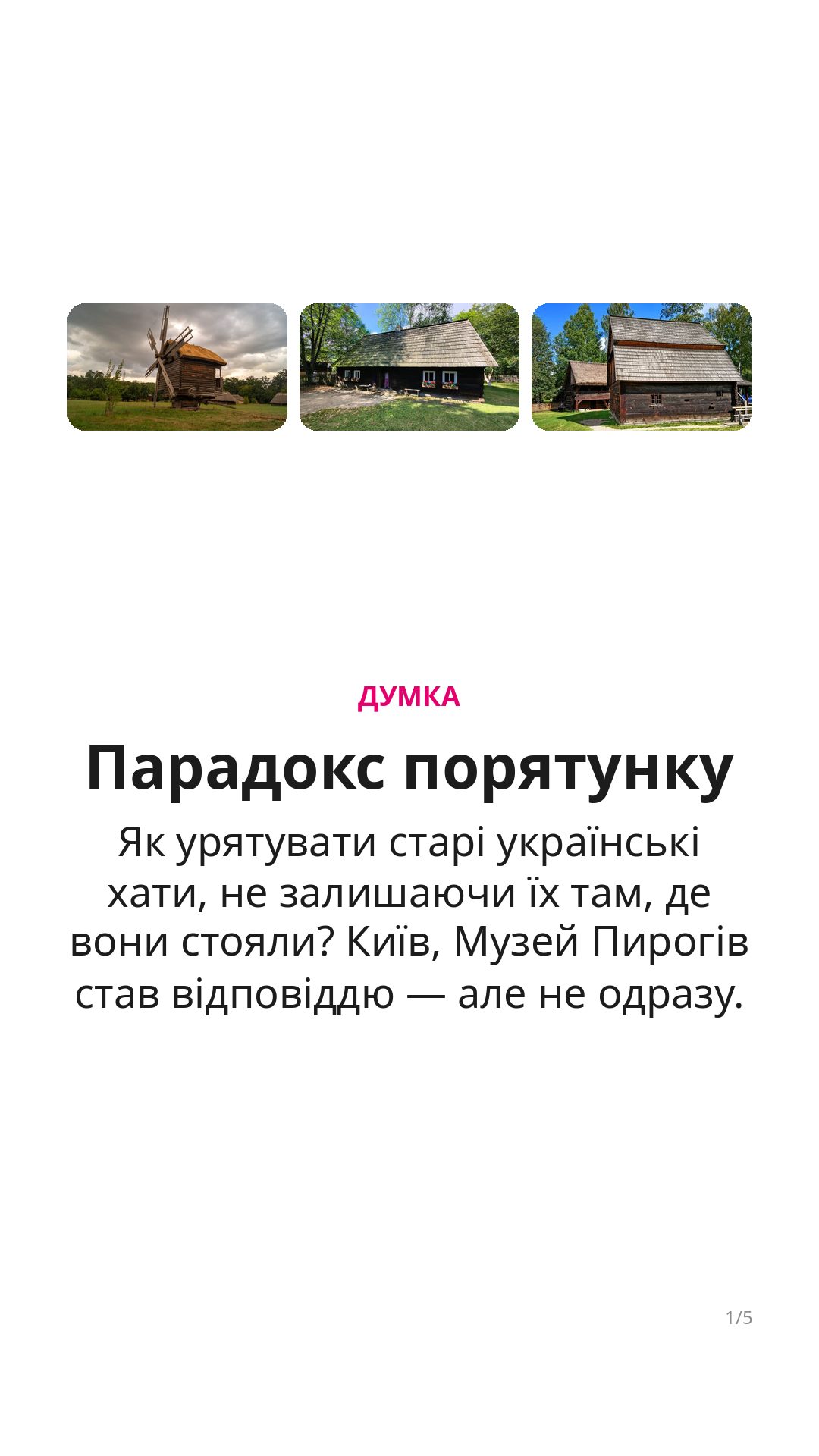
How to save houses without leaving them in place?
How to save old Ukrainian houses without leaving them where they stood?
The idea of the museum arose not as a plan for a picturesque walk, but as a way to preserve folk architecture at a time when its monuments needed saving. Petro Tronkо became the driving force behind the project, and seven years of forming the exhibition transformed Pirohiv into a place where Ukrainian regions are represented not by copies, but by transported monuments.[1][5][6]
History
1. The paradox of salvation
How to save old Ukrainian houses without leaving them where they stood? Kyiv, the Pirohiv Museum became the answer — but not immediately.
Pirohiv did not arise by itself as a collection of old houses. The idea of creating the museum is associated with Petro Tymofiyovych Tronkо — a historian and statesman. The formation of the exhibition began in 1969 when the museum concept transitioned into practical work. Over seven years, the team had to not only find buildings but also compile a coherent narrative about folk architecture from them. This long work explains why the museum reads as a conceived map rather than an accidental collection.[1]
More details: https://pirogovo.org.ua/en/history-of-the-pirogovo-museum-creation.html
2. It started with a letter
August 1965. "Literary Ukraine" publishes an open letter: to create a national museum in the open air. The idea enters the public space.
A public initiative preceded the government decision about the museum. In August 1965, prominent Ukrainian scholars and cultural figures appealed through the newspaper "Literary Ukraine" with a call to create a museum of folk architecture and life in the open air. The initiative is associated with architect Serhiy Verhovskyi. This stage shows that the idea grew not only from an administrative decision: it was initially formulated as a need to preserve cultural heritage. A few years later, the idea received state support.[8]
More details: https://www.libr.dp.ua/?do=ukrainica&lng=1&id=37&idg=306
3. A name that moved the matter
Petro Tronkо takes on the idea. In 1969, the formation of the future exhibition of the Pirohiv Museum in Kyiv begins.
The founding date of the museum is considered to be February 6, 1969. At that time, the Council of Ministers of the Ukrainian SSR adopted a decision to create the State Museum of Folk Architecture and Life. The initiative of the public and the work of the Ukrainian Society for the Protection of Historical and Cultural Monuments became part of the prehistory of the project. Several years passed from the resolution to the opening for visitors: the museum first needed to be designed and filled with monuments. Thus, the founding date marks the beginning of significant work, not the day when the ready museum already welcomed guests.[5]
More details: https://pyrohiv.org.ua/pyrohiv/about/istoriya-muzeyu-pyrogovo
4. Decisions and patience
February 6, 1969. The government adopts a resolution on the creation of the museum. Next — seven years of work to gather the first stage by 1976.
Seven years passed between the beginning of the exhibition formation and the opening. During this time, monuments were selected, transported, and museum complexes created. The history of the museum notes that the work was complicated not only by the selection of exhibits but also by party intrigues. In 1976, the construction of the first stage was completed, and the museum opened to visitors. Behind the familiar landscape with houses stands a long process of preserving and reproducing architectural heritage.[1][6]
More details: https://pirogovo.org.ua/en/history-of-the-pirogovo-museum-creation.html
5. From idea to place
The open-air museum in Pirohiv collects transported monuments from the regions, among them — the only 16th-century house in Ukraine. The answer: historian Petro Tronkо initiated...
During the formation of the collection, it was possible to find and deliver a 16th-century Ukrainian house to Pirohiv. The history of the museum calls it the only such house in Ukraine. This fact reminds us that the museum was not just collecting typical samples for an ethnographic picture: individual structures have exceptional historical value. The transportation of the monument allowed it to be preserved in a museum environment. At the same time, such findings explain why the idea required searching throughout the country, not just building new pavilions.[6]
More details: https://pirogovo.org.ua/history.html
Location: Pirohiv Museum.