
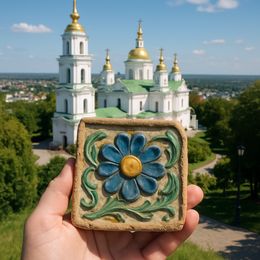
In Poltava, there is a reason to pay attention to the Monastery Hill: archaeologists have found several hundred artifacts here, among them a fragment of a stove tile associated with the times of Hetman Ivan Mazepa. For the city, this is indeed a rare find: researchers note that similar ceramics have not been encountered in Poltava before.
What is Most Interesting Here
The find dates back to the 17th-18th centuries, a period that well illustrates the everyday life of ancient Poltava. Among the unearthed items, ceramics of various uses prevail — dishes, bowls, goblets, mugs, including both local and imported products. The tile fragment attracts attention also because it has a multicolored glaze — yellow and blue shades, and it is likely connected to the workshops of Baturyn during Mazepa's time.
Is It Worth a Visit
If you are interested in the history of Poltava not from textbooks, but through tangible items, then yes — this topic is worth your attention. This is not a loud "sensation," but rather a case where a small fragment of pottery opens up an entire layer of urban past. Monastery Hill itself is already an important historical location, and such finds make it even more meaningful for a stroll or a conversation about the city.
What This Adds to the Image of Poltava
Such artifacts remind us that Poltava in the early modern period was not a periphery, but part of the vibrant cultural space of the Hetmanate. Individual finds from this area show how the monastic center, urban life, and the material culture of its time coexisted here. That is why the tile fragment is interesting not only to specialists but also to anyone who loves the city for its hidden stories.
So, if you want to see Poltava more deeply and feel how the era of Mazepa emerges in it, this topic is definitely worth your attention — are you interested in such stories from urban excavations?