
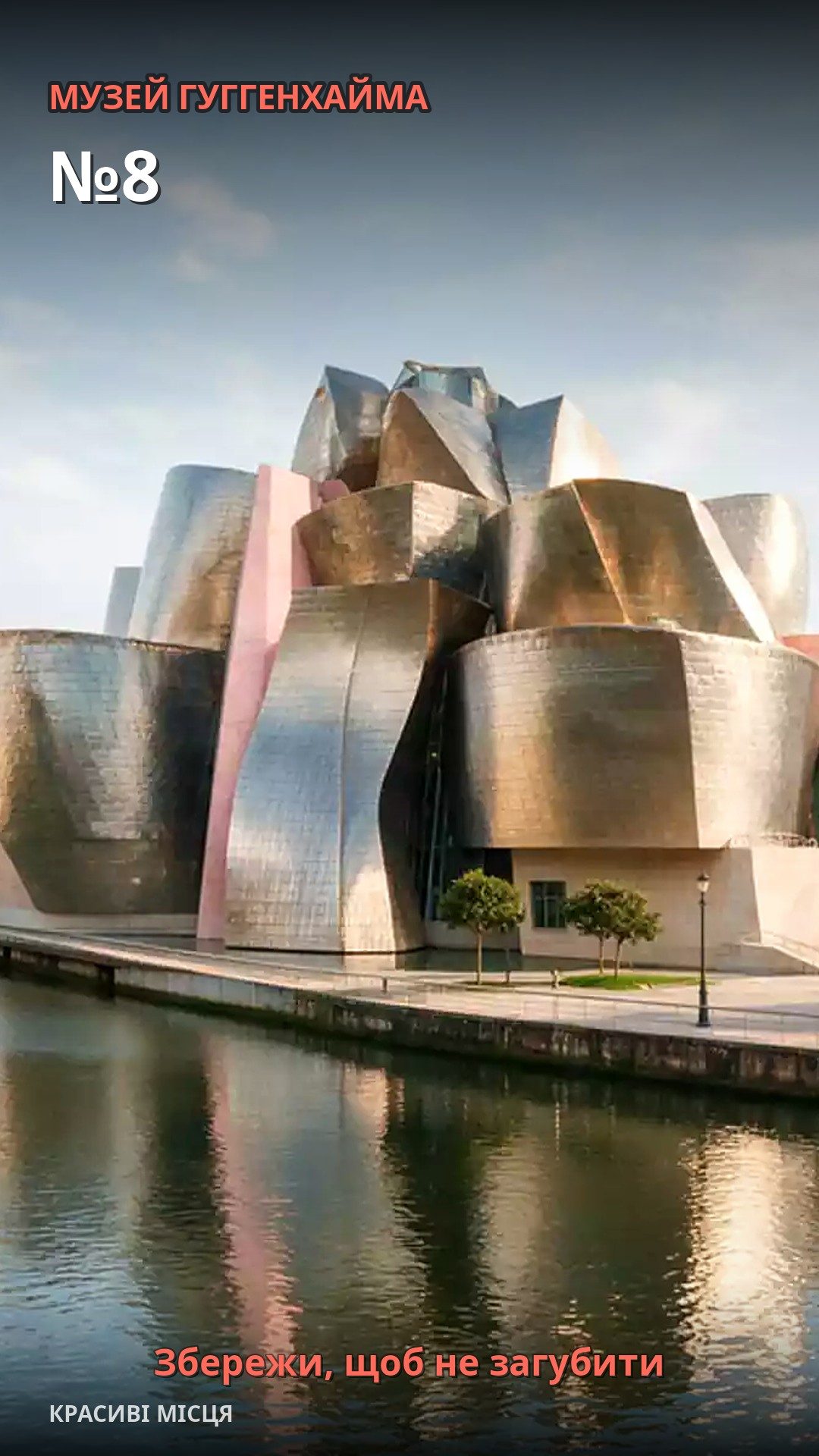
The Guggenheim Museum in Bilbao is a place worth visiting even for those who do not consider themselves fans of contemporary art. At first, you are struck by the building itself: curved titanium panels, reflections of light, and an unusual shape by the Nervión River. Here, architecture not only frames the exhibitions but actually becomes the main exhibit.
Why this place is special
The museum was designed by American architect Frank Gehry. The building was constructed between October 1993 and October 1997 on the site of a former port and industrial area along the bend of the Nervión River — the area was transformed into a cultural and public space.
For the complex curved forms, Gehry used CATIA software, which was originally created for the aerospace industry. That’s why the museum looks as if it was assembled from metallic waves: it almost has no sense of a traditional rectangular box.
What to expect inside
The museum opened to the public on October 19, 1997, with its first exhibition "Guggenheim Museums and Art of This Century." Its collection spans contemporary art from the second half of the 20th century and works by contemporary artists from America, Europe, and the Basque Country.
However, coming here just for the paintings is not necessary. The museum's spaces are designed so that art interacts with architecture, and individual works have been specifically developed for particular halls. So even a short visit can be memorable not for the names of the exhibits but for the scale, light, and sense of movement within the building.
The museum stands right by the Nervión, and its voluminous forms are clearly visible from various points in the city. Before entering, take your time: look at the facade from the river side, walk around, and give yourself time to notice the details. If you love photography, this is one of those locations where interesting shots are found almost without searching.
Would you like to see the Guggenheim Museum in Bilbao live — more for the architecture or contemporary art?